
High Arctic Cold Records; Antarctica Back Below -80C; Southern Chile Drops Below -20C; + The “Global” Temperature Record Was Never Truly Global
The High Arctic has extended its record-cold summer with three consecutive July records.

High Arctic Cold Records
The High Arctic has extended its record-cold summer with three consecutive July records.
The daily mean across the entire region north of 80N fell to -0.35C (31.4F) on July 26, the coldest July reading in DMI’s 1958-to-2026 dataset
This was followed by -0.26C (31.5F) on July 27, the second-coldest July daily mean.
And then -0.16C (31.7F) on July 28, breaking the previous record for the date and ranking as the fourth-coldest July reading in the 69-year series.
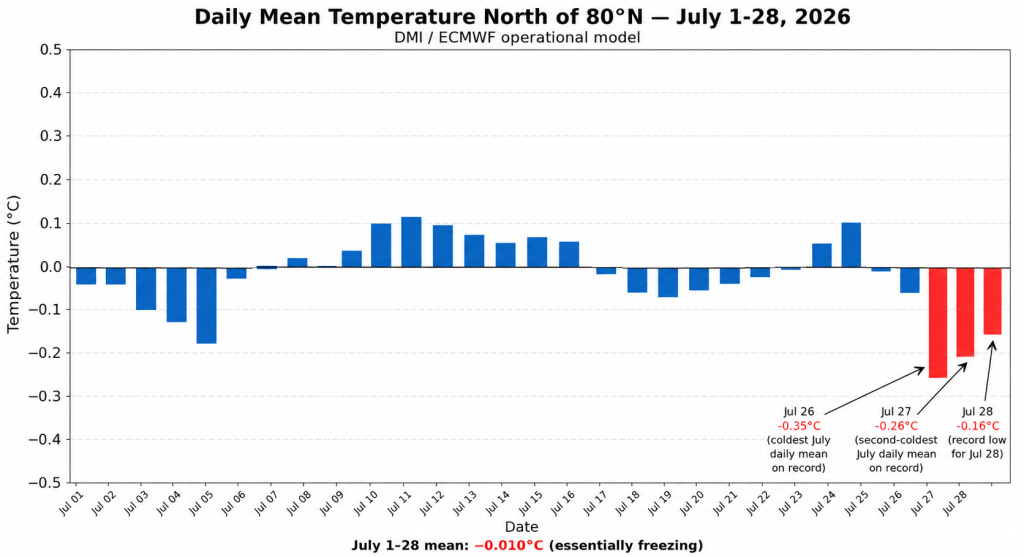
The July 1–28 mean now stands at -0.010C (31.98F)—freezing.
Combined with June’s record-low mean of -2.20C (28.0F), summer 2026 is averaging -1.14C (29.9F) through July 28, almost a full degree colder than the next-coldest comparable year.
The -5.30C (22.5F) on June 1 this year is also the coldest June daily mean in the books.
Summer remains missing in the High Arctic.
Antarctica Back Below -80C
As expected, Antarctica has breached -80C (-112F) again.
