

Hunga Tonga’s Water Vapor Remains Aloft
The Jan 2022 eruption of Hunga Tonga–Hunga Haʻapai injected 150 million metric tons of water vapor directly into the atmosphere, increasing the stratosphere’s total water burden by about 10%—the largest disturbance ever recorded.
Water vapor is the atmosphere’s most abundant greenhouse gas and the largest contributor to Earth’s natural greenhouse effect. In the lower atmosphere it largely acts as a feedback, rising and falling with temperature. Hunga Tonga propelled water directly into the stratosphere, where it can alter radiation, ozone chemistry and atmospheric circulation.
The disturbance is still present in July 2026.
Satellite observations show that by early 2025, around 75 million metric tons—approximately half the original excess—had been removed. The remainder is decaying with an estimated three-year e-folding time and is expected to return to the pre-Hunga range around 2030.
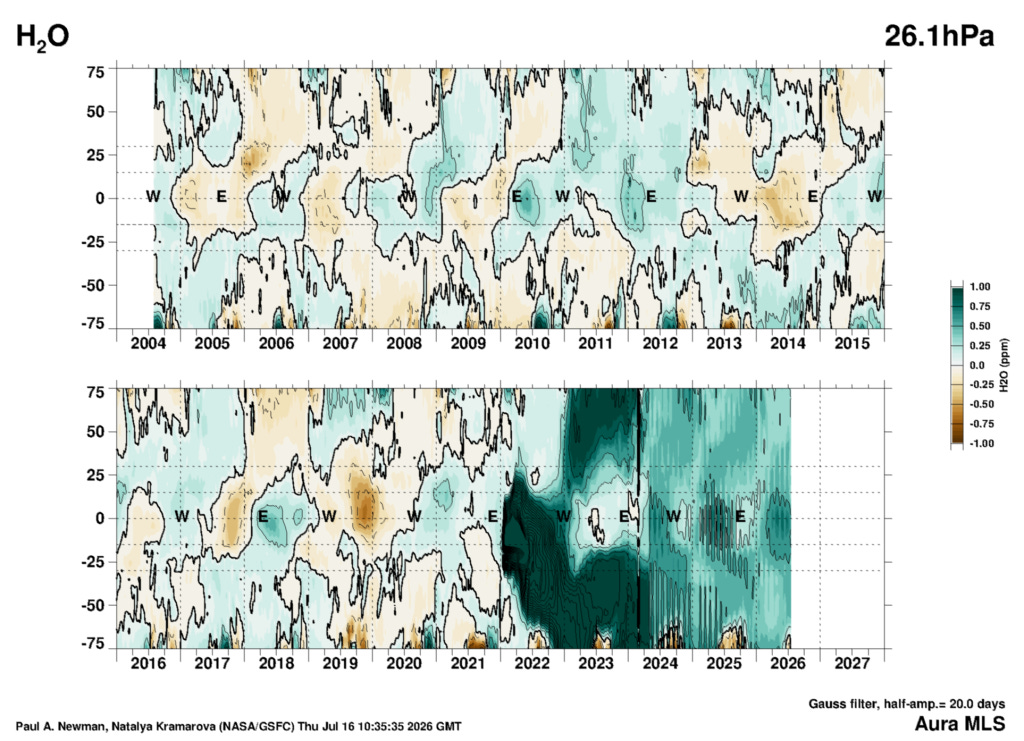
This added moisture increased downward infrared radiation.
Even NASA said a temporary warming effect was possible post-eruption.
It can be logically assumed that the eruption is influencing regional weather, but the precise contribution to individual events is of course difficult to isolate. Attribution science will, for example, claim with a high degree of confidence that “human CO2 emissions made the recent heatwave in western Europe 300x more likely,” but will also admit any impacts from Hunga Tonga cannot be quantified.
